
For decades, crisis management followed a familiar pattern.
A problem emerged. News coverage intensified. Communications teams responded with interviews and statements. Eventually the headlines faded, journalists moved on, and public attention shifted to the next big thing. Generative search has fundamentally changed that lifecycle.
Today, customers, investors, job candidates, and procurement teams consult generative search platforms before making decisions. Instead of reading dozens of articles themselves, they receive a synthesized narrative about your company.
Generative AI has become a reputation auditor, scouring digital environments for the elements of brand perception. Every prompt is effectively asking: “Based on everything available online, what should I believe about this company?”
The response is built from years of third-party commentary, owned content, regulatory actions, review sites, and viral crisis coverage. AI search lays your entire digital ecosystem bare, forcing crisis management to evolve from influencing headlines to managing the digital landscape.
Brands must audit and organize their digital assets to ensure generative AI can find, reveal, and support their preferred narratives.
Every AI Prompt Is a Reputation Audit
Public relations was built to influence what people are talking about today. But generative AI evaluates the entire historical record. A communications team may navigate a difficult news cycle, calm investors, reassure customers, and reduce media attention. From a traditional crisis management perspective, the organization has recovered.
But AI doesn’t care if a crisis was successfully managed. It evaluates what the entire internet says about the company and determines which narratives to spotlight. If the digital record is dominated by controversy, AI-generated answers will reflect that. These answers can persist even after the underlying issue is resolved.
How Generative Search Changes Crisis Management
Generative AI changes crisis management in three important ways.
It strips away nuance
A major corporate crisis often produces hundreds of articles, analyst reports, regulatory filings, social conversations, and opinion pieces. Historically, stakeholders had to find and interpret those sources themselves. Generative AI does that work automatically, producing a tidy, concise summary. These summaries repeat click-driving headlines about fines, penalties, and regulatory actions while leaving out the brand’s perspective.
It suggests consensus and authority
Generative search often delivers its responses in an authoritative, factual tone, using language such as:
- “The company has faced criticism…”
- “There are ongoing concerns…”
- “The organization has been accused of…”
Even when articles contain conflicting viewpoints, speculation, or errors, the AI response can appear to represent a definitive consensus. This can be especially harmful when high-profile accusations are proven false. Without correction, generative AI may continue reporting a false outcome.
It extends the life of a crisis
All news cycles eventually end, but digital records live forever. A past crisis that receives zero media attention today can now become fuel for a controversial AI-generated response, especially if the underlying content holds sway in the digital landscape.
Unrelated incidents can look like patterns to generative AI. This is a problem for smaller companies that don’t receive media attention frequently enough to refresh the online narrative.
Crisis Management Examples From Recent Headlines
Let’s look at two recent crises to see how one brand controlled its narrative in generative search, and the other didn’t.
1) Navient’s lawsuit fallout
Years after its settlements and legal disputes, Navient’s digital footprint continues to be dominated by lawsuits, CFPB bans, and borrower complaints, giving AI systems little choice but to incorporate them into responses.
Although the crisis ended for Navient, unfavorable information ensures negative AI responses. Today, if a prospective borrower asks Google whether Navient offers student loans, the AI Overview tells them to look elsewhere.
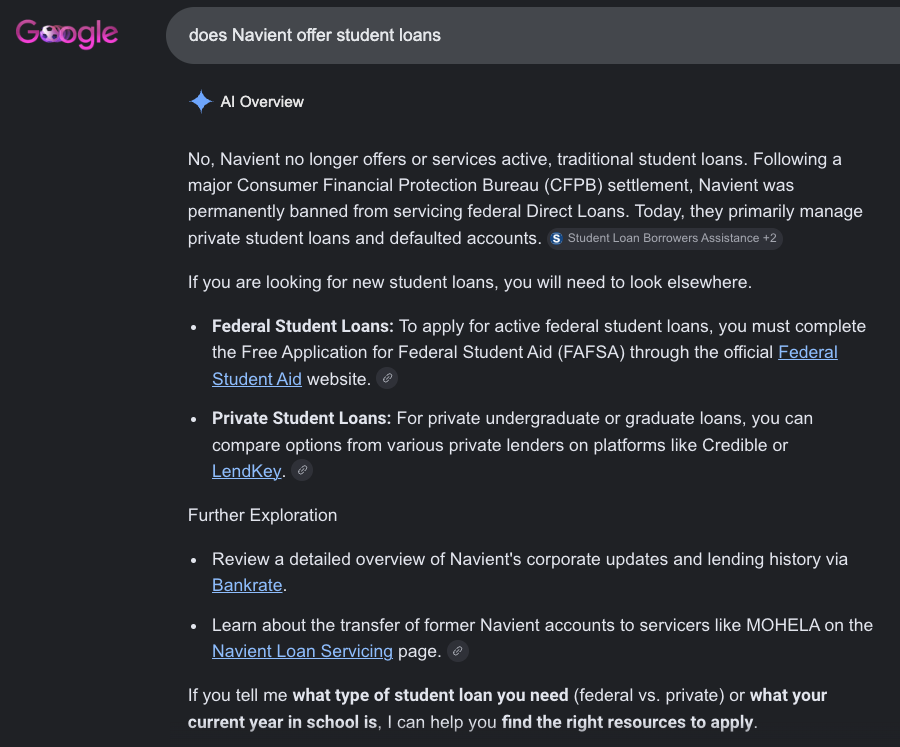
A favorable response would direct students to Navient’s subsidiary brand, Earnest, for private student loans. Instead, AI Overviews sends borrowers to Credible and LendKey and brings the controversy to the forefront.
2) The Campbell’s Company crisis
When a leaked recording captured a Campbell’s executive making offensive remarks about the company’s food, Campbell’s publicly defended its products and investigated the executive’s conduct. The company issued statements clarifying that the executive’s purview was technical in nature. The brand also published information on its website explaining its use of real chicken sourced from USDA-approved suppliers. Campbell’s later confirmed that it had parted ways with the executive.
Rather than allowing third-party coverage to define the company, The Campbell’s Company corrected the record through proactive PR and rich, authoritative, and balanced digital assets. That content provided consumers, journalists, search engines, and generative AI with favorable information to reference.
Campbell’s did not erase the controversy, but it established a clearer factual record and limited the potential reputational damage.
Can Organizations Actually Influence AI?
Yes, but not by attempting to optimize AI systems directly. Generative AI reflects the content and information ecosystem surrounding a brand. Therefore, the target is obvious. Invest in reputation management by creating owned content, consistent messaging, authoritative PR visibility, and a healthier branded search experience.
We’ve seen the impact of these strategies firsthand:
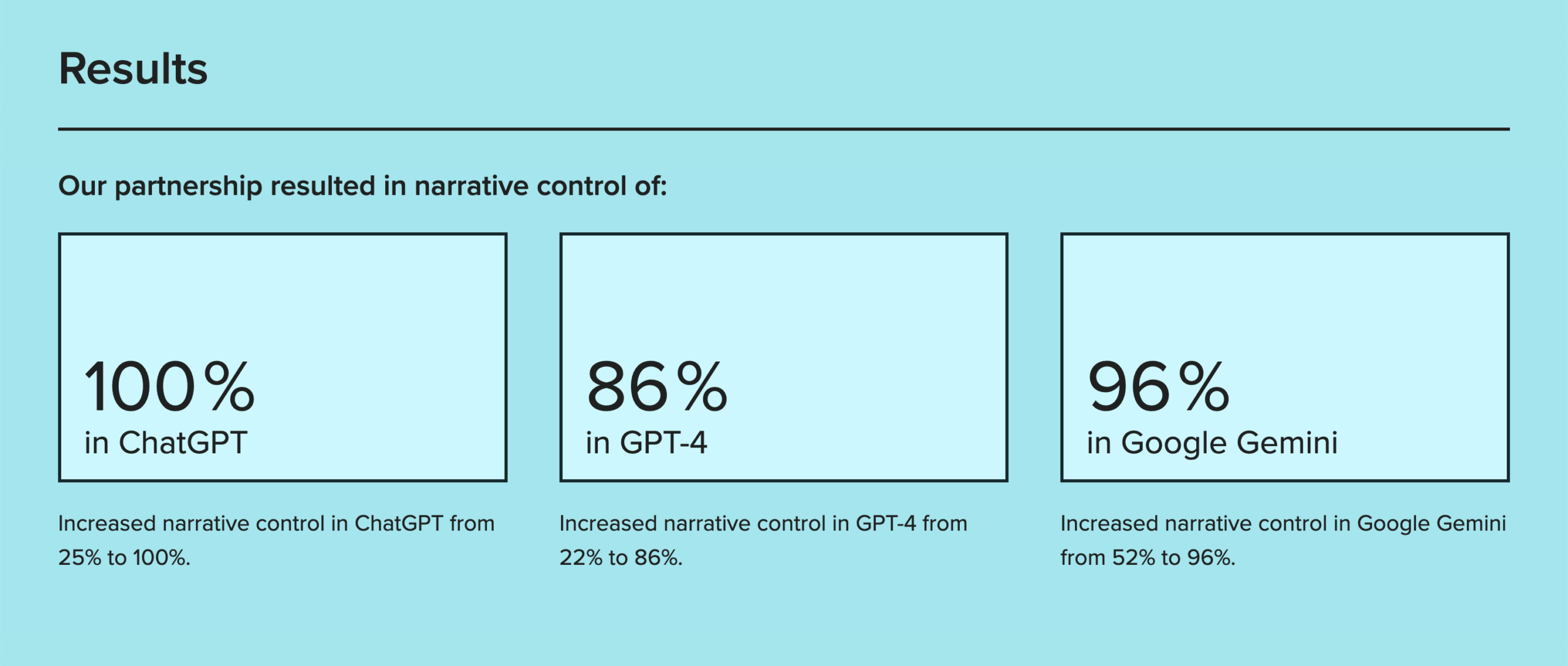
In one engagement, a financial industry executive achieved 94% controllability across ChatGPT and Gemini, boosting the consistency and accuracy of how AI described their professional reputation. In another, a global software company transformed broken messaging into a consistent narrative across search and AI.
Neither outcome involved unethical manipulation of AI responses. Both resulted from a strong digital ecosystem and strategic communications.
The bottom line is that improving the quality, number, and authority of brand assets improves your company’s representation across the most vital online channels.
Modern Crisis Management Requires a Second Recovery Phase
Traditional crisis communications is a must. Brands need experienced comms experts to engage media, reassure stakeholders, coordinate messaging, and respond when issues emerge. But PR and comms alone are insufficient.
A two-phase crisis approach is best. The first phase stabilizes today’s conversation and narrative. The second focuses on rebuilding brand reputation and maintaining it in the longer term.
Start by mapping how your organization appears across search and AI. Identify where outdated narratives are shaping perception. In addition to PR and comms, develop owned content to ensure the record reflects reality instead of the worst moment of a temporary crisis.
Generative AI doesn’t ask whether your crisis was managed successfully. It asks what the internet believes about your company. And increasingly, that’s the answer your stakeholders believe, too.
Google Search has drastically changed. Sure, the search results appear if you scroll down far enough. But the results most searchers are looking at? AI Overviews at the top, perhaps the clearest example of generative search.
AI Overviews is a small, bolt-on addition to Google’s user interface, but it reshapes how audiences discover and evaluate brands, as well as the way your brand is perceived. Its responses pull from live web content based on many traditional ranking signals, but it aims to solve user queries on its own, pushing users away from brand sites and deeper into the AI-driven search environment.
Users now engage with brands completely outside of owned channels like your website, AI search becomes the first brand-audience touchpoint. What it says to billions of users can make or break brand perception, narrative, and reputation.
Let’s start with what generative search is and how its unique value proposition evolves the entire search landscape.
Generative search essentials
What is generative search?
Built on the foundation of generative AI and large language models (LLMs), generative search extends genAI’s capabilities from creating content and chatting with users to answering complex user queries along with sources and follow-up suggestions.
While Google’s AI Overviews is the most literal version of generative search due to its implementation in Google’s ecosystem (along with Gemini and AI Mode), it’s just one of many generative search platforms like ChatGPT, Perplexity, and Claude.
The generative search evolution
The days of ‘Googling’ aren’t over, but consumer paths are more diverse than ever before. There’s less need for digging through search results when AI can solve your queries quickly with purpose-built answers.
Especially important for brands, generative search “turns on” when a user asks any of these platforms for an answer that:
- Requires timeliness
- Requires a high degree of accuracy
- Relates to high-consequence decisions.
That means virtually all brand-related queries are within generative search’s purview. Getting the right narrative, therefore, means building positive, brand-friendly results in the source material — the content that ranks in traditional search.
The impact on audiences
The shift to generative search is changing engagement, but it’s also shifting how brand perception is created, and ushering in new risks and vulnerabilities. The most important audiences include consumers, customers, prospective and current employees, investors, stockholders, and regulators.
A risk assessment
Generative search doesn’t just affect marketing performance. It redefines how every critical audience understands, evaluates, and judges your brand. Here’s the search dynamic across four key audiences:
| Customers | Employees | Investors | Regulators | |
|---|---|---|---|---|
| Behavior | Discover, evaluate, and decide via AI, often before visiting a website. | AI-generated summaries shape first impressions with content from third-party sources. | AI synthesizes news and financial signals to shape investor perception. | AI blends sources, increasing spread and opacity of misinformation. |
| Risks | Inaccurate info, negative bias, or brand exclusion. | Incomplete, outdated, or unfair portrayals. | Overemphasis on controversy or perceived risk. | Investigations, reputational harm, and operational disruption. |
These changes in audience behavior, fueled by AI’s fast evolution into a unified search solution, pose complex challenges. A valuable and controllable channel shifted from a protective layer for brand reputation to an AI-driven battlefield.
In this environment, brand visibility isn’t about ranking alone. It’s about influencing and inserting your narrative into the source material LLMs trust. Brands need to achieve this consistently and across channels, and make a long-term shift.
What brands and leaders can do
Start by adopting an AI-focused proactive approach to guide your brand forward. The key is a reorientation around a few foundational elements:
- Monitoring
- Measurement
- Content strategy
- Online reputation management
Together, this foundation allows you to understand your space and dictate your story.
Here’s where to begin:
1. Prioritize monitoring generative search
Brand visibility in the AI environment is mission-critical, but it’s also an opaque frontier that requires expertise. It’s not as simple as Googling yourself or your brand; that approach leaves out most of the picture. You need to be able to map the landscape to see the gaps and vulnerabilities, and then take strategic action to solve them.
Generative search monitoring should target your brand name, product categories, and comparisons, as well as high-risk, narrative-damaging information. It reveals the following: if your brand is being included in AI answers, if your assets are used as sources, the accuracy of AI answers, and the sentiment (good, bad, neutral) being shared.
2. Plant seeds in AI’s source material
As discussed earlier, AI search needs sources. It requires material from the web to effectively answer user questions. In the brand context, when AI goes looking and finds negative content or gaps, it tends to output more of the same.
Brands must proactively offer controlled sources by creating targeted content assets that will help AI understand your story across the key search topics (brand name, product categories and comparisons, high-risk info). AI will use these controllable assets for generating answers, creating brand influence over what’s generated.
3. Lead with ORM, not just SEO
If it appears in search, SEO is all that matters, right? Actually, this is no longer the case. Brand visibility success means leaning into online reputation management (ORM) for solutions.
ORM leverages SEO tactics, but it also uses aspects of PR to build a trustworthy reputation across all fronts. Content strategy matters, but so does thought leadership, press mentions, and earned media. Brands need the complete package.
SEO provides search result control, but it does not, on its own, provide all the authority signals your brands need to build or protect your reputation or narrative in AI. The synergistic influence of ORM empowered by generative search monitoring is the solution.
4. Measure influence, not traffic
People rely on AI-generated summaries over actual website content. They get the answers they seek, but may skip your site entirely. That’s why traffic is becoming an irrelevant number for many industries. What matters today is influence.
In AI platforms, influence is a combination of these metrics:
- Visibility — Does your name or brand appear in generative search tools and summaries?
- Citation share — What percentage of brand-related AI answers source content you control?
- Sentiment — What’s the overall perspective on your brand? Positive, negative, or neutral?
- Accuracy — Are AI’s answers aligned with your brand story or reality?
- Consistency — Are you regularly visible, cited, positively portrayed, and accurately described or not?
5. Plug risk frameworks into the generative search context
You are likely operating with risk frameworks in place, but if the AI and generative search environment is excluded, that’s a worrying vulnerability. Brands should enrich their frameworks to include generative search as soon as possible.
Start by answering the most pressing questions:
- What qualifies as a significant misrepresentation that requires action to mitigate brand harm?
- What teams own response and escalation?
- When do we intervene and when do we monitor?
- What are the most important AI platforms to influence?
- How do we address the issues that appear in generative search?
This analysis can help steer your AI risk mitigation efforts and help prioritize action items. This is your initial step.
Take control or be defined
Generative search is no longer a future problem. It is now the front door to your brand. The brands that win will not focus only on rankings or traffic. They will actively shape the source material AI relies on, monitor how they are represented, and treat influence as the core measure of success.
That requires a shift from reactive SEO to proactive reputation management, and from page-one thinking to owning your narrative across the web. The real question is simple: will your brand help define the answers people see, or be defined by them?
Building a brand that consumers love and trust can take years of hard work. But one dent in your reputation can unravel that equity in a matter of hours. A strong reputation is crucial to business, now that AI-generated summaries and search results set the tone for how consumers perceive a brand.
The importance of a positive reputation
In the internet era, online reputation is everything. Think about your marketing strategy for a moment. Your paid team buys ads on numerous mediums like broadcast, print, digital, and display. You invest in public relations to get top-tier brand mentions. Your PR team sends out endless press releases to promote your products and services.
All of these efforts ultimately drive consumers to one place: Search. What potential customers discover there will shape their opinion of your brand. If it’s positive and in line with your brand messaging, your marketing efforts will be amplified.
However, if your Google results or AI summaries are negative, off-brand, irrelevant, or laced with competitor content, your marketing ROI will take a hit.
Online reputation affects offline brand perception
It’s easy to think of what happens online as separate from the “real” business. But today, your digital reputation is often the first and most influential touchpoint customers encounter.
Dozens of digital touchpoints form the lens through which people evaluate your brand long before they walk into a store, add something to their cart, or engage with your team.
A single negative review can lower both foot and online traffic. A polarizing news story can influence investor confidence. A wave of Reddit threads or TikTok commentary can shape expectations before someone ever experiences your product.
This means your online reputation isn’t just an asset, it’s a predictor of offline outcomes like purchase decisions, hiring success, partnership opportunities, and customer loyalty. The story people see online becomes the story they believe offline.
How AI shapes brand reputation
AI has become one of the most powerful forces influencing how people understand, evaluate, and talk about brands. Search engines, social platforms, and generative models now pull from millions of online signals to create summaries, rankings, and recommendations. These AI answers shape consumer perception long before someone visits your website.
In this environment, AI isn’t just reflecting your reputation; it’s actively constructing it. Brands that don’t manage the quality, consistency, and availability of their digital signals risk having incorrect narratives define them.
Why Reputation is Important
- 44% of C-suite executives would override a decision based on AI insights (SAP)
- 55% of companies with $5 billion or more in revenue, AI-driven insights have replaced or frequently bypass traditional decision-making (SAP)
- Generative AI tools influence 64% of purchase decisions (Profound)
- 58% of consumers use generative AI tools instead of traditional search engines for product recommendations. (Capgemini Consumer Trends 2025)
So, we know that online reputation is important because it impacts real-life behavior like hiring and sales. And legions of potential customers, stakeholders, and employees read what people say about your brand online.
The value of a CEO’s reputation
A CEO’s reputation impacts entire organizations.
This connection wasn’t as strong several decades ago when business owners rarely ventured beyond the boardroom. Now, news cycles erupt instantaneously, and CEOs have countless platforms to express their unfiltered thoughts. Fortunately, many executives now understand how their personal brand influences the company’s reputation.
74%
74% of executives believe their customers tie brand reputation to executives reputation
Because CEOs are the face of their company, personal statements have dire consequences for the brands they lead.
Reputation examples and lessons
The link between a CEO’s public persona and a company’s brand reputation has never been stronger. In an era where AI systems instantly summarize public sentiment, executive actions can shift market perception in real time.
Few leaders illustrate this dynamic more clearly than Elon Musk. His rapid, unfiltered communication style and high public visibility consistently influence how consumers and investors view Tesla.
When Musk makes controversial statements or policy decisions on social platforms, Tesla often experiences immediate fluctuations in stock price and brand sentiment. Musk’s reputation directly colors the narrative around the Tesla brand.
A different but equally instructive example is Target. In 2025, the company faced intense backlash around operational decisions that quickly escalated through online discourse. Even though Target’s CEO wasn’t personally at the center of the discourse, leadership decisions became inseparable from how consumers perceived the brand.
The situation triggered a measurable decline in consumer sentiment, online visibility issues, and lost earnings. It demonstrated that executive-level choices can materially shift brand trust almost overnight.
These examples show how modern brand reputation is executive reputation. The people at the top shape the stories consumers see in search results and increasingly in AI-generated content.
Why corporate reputation matters
According to Harvard Business Review, a strong reputation allows businesses to:
- Attract better people
- Charge a premium
- Enjoy strong customer loyalty
Furthermore, HBR explains that because these companies reliably provide sustained earnings and future growth, they have higher price-earnings multiples and market values as well as lower costs of capital.
The impact also extends to consumers.
Generative AI chat platforms and Google Search give consumers instant access to limitless information, allowing them to choose between more companies and do more research than ever before.
New customers can read product reviews, investors can learn about a CEO, and job seekers can research a prospective employer. For better or worse, these online platforms are crucial drivers of corporate reputation.
Negative employee reviews will turn away top talent and force you to spend more money on recruiting. A volatile CEO will scare off investors, diminishing access to capital. And bad customer reviews prevent you from being able to increase ecommerce sales.
Why brands must prioritize online reputation management
It’s probably evident by now that your company’s reputation is its most important asset. But far too often a brand’s online reputation is out of sync with the real world.
That’s because algorithms and large language models are constantly shaping brand visibility and perception. And what fuels these models are digital assets that exist across a range of owned and third-party websites.
If you aren’t actively creating, controlling, and influencing these online assets, you’re leaving your brand’s narrative — and the decisions of customers, investors, and talent — completely in the hands of others.
However, if you know how to leverage those signals, you’ll be able to influence what appears in search and AI-generated answers.
That’s where reputation management comes in. Reputation management acts as the moat and drawbridge to your brand’s digital fortress. Not only do reputation management firms protect your brand, they also build up the kind of favorable content you want your customers and stakeholders to find, right when you want them to find it.
With that, let’s dive into the importance of online reputation management (ORM).
Market share & market value
The market is saturated with good brands vying for customers’ attention. It takes a monumental amount of effort, resources and time to stand out in this highly competitive marketplace. But, most importantly, you need a great reputation.
A recent study found that 8 out of 10 companies saw an improvement in their market value when they improved their reputation. Furthermore, per the previously mentioned Forrester Consulting study, 41% of brands believe reducing undesirable search results would increase market share.
41%
41% of brands believe reducing undesirable search results would increase market share
Your brand’s market performance depends on maintaining a positive brand image.
Revenue
It’s nearly impossible to tie reputation to an exact dollar amount because there are far too many variables. But we do know that brands with a bad reputation pay heavily when it comes to revenue.
Want a more specific example? We helped a national furniture retailer recover approximately $32 million dollars in monthly revenue. Read the case study here.
Investors and board members
Investors are vital to the financial health of your business because they grant you access to capital (which fuels growth). This investment powers R&D, acquisitions, and team expansions.
Board members are also important for their connections and expertise. However, in exchange, investors expect to be rewarded with stable and consistent returns, not reputational risk.
Customers
Customers today have dozens of review websites at their fingertips. This is a great virtual word-of-mouth referral system. Not only can review sites rank in Google for your brand, but AI platforms and AI agents learn from them and other customer reviews.
Unfortunately, these sites can be magnets for angry customers to vent their one-sided frustrations. Negative reviews don’t always tell the full story, but they do heavily impact whether or not a customer chooses to do business with you.
According to Podium, 91% of 18-to 34-year-olds believe reviews are as trustworthy as a recommendation from an acquaintance.
Online reputation repair companies monitor brand reviews and carefully track sentiment to make sure they accurately represent your business. As a result, you’ll be able to step in and fix issues before they snowball out of control.
Employment
It’s not just customers who can leave online reviews about your business. Current and former employees can also leave feedback.
The employee-review site, Glassdoor, uses a star rating system for both the company and its C-suite executives.
Unfortunately, just like with customer review sites, Glassdoor can be a place for disgruntled employees to seek revenge against a former employer by stretching the truth, or completely misrepresenting it.
Since review sites rank very well in Google for branded keywords, one-star reviews could appear on the first page of your search results. These reviews are also being cited as sources in AI-generated summaries.
As a result, you’ll struggle to hire top talent, or you’ll pay a premium to convince them to work for you.
Sadly, it’s extremely difficult to get Glassdoor reviews removed. That means the only way to get rid of them is to elevate other content and positive reviews above them.
Partner with the leading reputation management company
We looked at numerous statistics about why it’s important to build a good reputation, including how a positive reputation impacts your bottom line.
The truth is, at the end of the day you need more than a handful of positive reviews if you hope to shape the opinions of others within your target audience. You need a comprehensive reputation marketing strategy that prioritizes your brand’s online presence just as highly as its offline presence.
We looked at numerous statistics about why it’s important to build a good reputation, including how a positive reputation impacts your bottom line. Then, we discussed the risks of not taking action or hiring the worst kind of reputation management company.
The truth is, you need more than a handful of positive reviews if you hope to shape the opinions of others within your target audience. You need a comprehensive reputation marketing strategy that prioritizes your brand’s online presence just as highly as its offline presence.
In this definitive guide, I’ll explain exactly what online reputation management is, what it isn’t, and how we use it to shape your digital image through traditional organic search and generative AI platforms.
The internet is the ultimate source of information. Whether people want to learn something, do something, or buy something, they turn to Google, and now emerging AI platforms like ChatGPT, Perplexity, and Gemini. In fact, even offline activities like conversations, watching an ad, or opening a magazine may drive people to search engines and AI chat platforms. And what they find online influences their perception of your brand.
Online reputation management asserts control over your digital narrative, influences audience behavior and sentiment, and positively impacts your brand’s online reputation.
But there are some limitations.
The vast majority of searchers never explore beyond the first page of Google. Consequently, brands and high-profile individuals only get as few as ten search results to tell their story. In tools like ChatGPT, your narrative is consolidated even further into a few sentences.
That’s a massive challenge when there are hundreds of thousands of articles about you on the internet, many of which could be biased or misleading.
Online reputation management ensures that your digital reputation is accurate, positive, and intentionally built. But what is it and how does it work?
What is reputation management?
Contrary to popular belief, ORM isn’t just review management and press release distribution.
Online reputation management (ORM) is a discipline that uses search engine optimization techniques to influence the search results of a company or individual in order to shape brand perception.
Today, proactive reputation management must also address the emerging AI technologies like Google Gemini and ChatGPT that create content in front of billions of eyes. A strategy called generative engine optimization, or GEO, should be part of a well-rounded ORM approach.
Aspects of reputational defense like crisis management and sentiment analysis become a major challenge if you ORM strategy can’t get a handle on AI search and generative platforms.Jonas Sickler, ReputationManagement.com
Most business leaders believe a positive reputation is important. However, they often fail to recognize that search is a key driver of their reputation. Furthermore, executives rarely understand how to effectively influence online sentiment or measure its financial impact on their company. As a result, business owners rarely take action to manage their online reputation, leaving it to chance.
To make matters worse, there’s also a lot of confusion about whether public relations firms or SEO companies are better equipped to tackle ORM. So, let’s dive into how ORM is different from search engine optimization (SEO) and public relations (PR).
Online reputation management vs SEO and GEO
Most businesses are familiar with SEO as a means of driving organic traffic by influencing keyword rankings. Today’s marketers also execute generative engine optimization to influence how AI engines are summarizing and surfacing information.
However, the vast majority of brands fail to capitalize on the power of search marketing for reputation management. So, what’s the difference?
Here’s the simplest explanation I can provide:
SEO is used to rank multiple pages on one website for many different keywords. While online reputation management is used to rank many different websites for a small set of branded keywords. Here’s another way to look at it:
The goal of SEO is to rank a single website number one for as many queries as possible. The goal of ORM is to fill the first page of Google with preferred content for brand-focused keywords. Think of it like this: reputation management is one inch wide and one mile deep, SEO is one mile wide and one inch deep.
Ultimately, ORM uses optimization principles and best practices to impact the search rankings to build a more accurate and diverse search landscape.
Reputation management vs public relations
The difference between online reputation management services and public relations is a little more nuanced. On the surface, it may seem like ORM is just public relations for online personas because they have similar goals, namely brand management. However, these two disciplines use different tactics to achieve different results.
Public relationscompanies generally create trending, buzzworthy news cycles to redirect the conversation around negative topics. The goal is to shift public perception by flooding social media and news outlets with a new viral narrative.
Online reputation management aims to tell a more accurate and holistic story about a brand or individual by positioning controllable assets on the first page of Google.
PR is good for shifting real-world sentiment. But, it falls short when it comes to influencing branded search results which drive reputation and allow companies to control their own messaging.
Why does negative content rank in Google?
Unfortunately, you may have already experienced just how sticky a negative news story about your brand can be. It’s not because Google has a personal vendetta against a single person or entity. It’s because Google’s algorithm is built to provide searchers with the best, most relevant set of search results for a user’s query. And if a brand or executive is managing a crisis, that content would be highly relevant.
That all said, there are a few main reasons negative content so frequently hits the first page.
Topic density
Topic density describes the percentage of content in Google’s index about a specific entity as it relates to other entities, topics, or events.
For instance, if you search Elon Musk in Google, you’ll find results about SpaceX and Tesla. It’s not because Elon Musk wrote in his bio that he created those companies. It’s because there’s so much content online that connects him to SpaceX and Tesla.
Unfortunately, topic density can also negatively affect a brand’s reputation. As an example, if a business was recently responsible for a toxic chemical spill, Google will prioritize articles about that event when people search that company’s name. What’s more, if the CEO made a decision that caused the accident, that person’s search results would also be affected.
Popularity
Backlinks are the new word-of-mouth referral, for better or for worse. If trustworthy websites link to a negative story about your business, that sends a strong signal to Google that it’s relevant and important. As a result, it may pop onto the first page of your search results where more people will see it. In turn, it will earn more clicks because people tend to click on negative headlines more often. Google will interpret these click signals as popularity and relevance, potentially pushing the result even higher.
Time sensitivity
When it comes to news stories, Google loves timeliness. Which means any trending topic — positive or negative — will be given more weight in the SERPs. It’s possible that these stories could fade away when they become stale. However, viral content on trusted sites often earns a lot of links, which gives it more sticking power.
Negative AI Bias
Negative content often ranks prominently in Google because AI systems in both search and chat tend to overweight signals that appear highly engaging, frequently referenced, or emotionally charged.
Unfortunately, negative narratives check all three boxes: they generate more clicks, more discussion, and more cross-linking than neutral or positive content. As a result, AI doesn’t just surface negativity, it reinforces it and interpret repeated critical signals as authoritative.
Without intentional reputation management, a small cluster of negative posts, reviews, or Reddit threads can have an outsized influence how Google interprets a brand’s relevance and credibility.
How does online reputation management work?
There are so many misconceptions floating around about online reputation management. For example, it’s not negative SEO, and firms don’t magically delete negative results. That would be hacking, and it’s highly illegal.
ORM is actually about creating a more balanced and accurate search landscape. It’s about telling your story on the first page of Google by controlling more of the content that appears there. Let’s break down a few more misconceptions about how digital reputation management works.
Balancing out search results
Online reputation management involves offsetting negative content with brand-controlled content that offers a more balanced narrative. This process plays a key role in making sure the first page of Google accurately reflects your personal and professional brand.
Moreover, before you can mitigate negative results, you’ll need to create positive content about your brand to promote. Content marketing for ORM means publishing and optimizing lots of original, thoughtful, keyword-driven articles, videos, images, and blog posts. It also means promoting that content through link building to ensure customers find it.
SERP diversity
Google tends to favor diversity in its search engine results because its goal is to provide the best set of results for each query. Since it’s not always clear what searchers want, Google serves a range of content for branded searches. So, what does an established, positive online presence look like for brands and CEOs? It usually contains a mix of the following:
- Websites
- Blogs and forums
- Positive reviews
- Thought leadership
- Videos
- Images
- News articles
- Social profiles and social media channels
Ultimately, it’s easier to promote an accurate narrative in Google when your search landscape is packed with well-diversified, accurate content designed to build trust.
Accuracy, balance, and integrity
High-risk internet reputation management companies typically use smokescreen tactics to mask a person’s identity because it’s a cheap and easy tactic. They do this by creating dozens of digital doppelgangers to clog up the top ranking spots in the SERPs with fake personas that share your name. While that tactic may work for the average Joe, it won’t remove news articles from Google about a global brand or its chief executive.
The only way to truly build a long-term, positive reputation online is to establish a truthful, accurate search presence that portrays your legacy, accomplishments, and preferred brand messaging. Any other type of tactic is bound to fail and will ultimately create a bigger disaster to clean up down the road.
A negative online reputation has real-world consequences
It can be easy to discount what happens online as unimportant and disconnected from your real-world business. But that simply isn’t true anymore. A negative online reputation impacts your personal brand image as well as just about every level of your business.
Search results are your digital resume
Think of Google like your digital resume. You’d never submit a resume for a job if the top bullet point read “Fired for lack of performance,” right? Unfortunately, unlike the printable version of your resume, you can’t just remove unwanted search results. Everything you ever said, wrote, or posted online, including what others wrote about you, is discoverable.
What do people find when they Google your name, or your company? If the answer is unfair viral news stories about your personal life, or negative reviews about your products and services, you need to update your virtual resume.
Your online reputation is permanent
Because Google almost never removes negative search results from its index, your online reputation is more or less permanent. Negative stories aren’t paper documents that you can shred or burn. They’re part of the digital archive forever.
Even social media comments that you quickly delete can be immortalized with a screen shot, posted in articles, and syndicated thousands of times.
What’s more, seemingly minor, unfavorable stories can stay stuck on the first page and leave a sour impression with the people that matter in business. With so many potential customers, shareholders, and prospective employees relying on Google, it’s only a matter of time before someone in your professional sphere stumbles on a negative page one result.
CEO reputation risk
Reputation risk has different meanings and consequences for executives and the corporations they lead.
As a CEO, your online reputation extends into both your personal and professional lives. Negative search results skew your accomplishments and shine a spotlight on a single event that doesn’t define who you are or what you’ve done. They overpower your philanthropic efforts, embarrass your family and friends.
Negative articles might also cause clients and partners to question their trust in your leadership, which could impact the trajectory of your professional career, and even impact your company’s financial health. In fact, one CEO’s bad reputation cost his company more than $96 million within a few short hours.
Corporate reputation risk
Corporations are held to higher standards than ever before, too. Consumers now expect brands to invest in environmentalism and ethical treatment of workers. In fact, those issues often influence consumers’ purchasing decisions. So, if potential customers discover an unfavorable headline about workers’ rights in your search results, it could overshadow years worth of corporate social responsibility efforts.
Furthermore, sensitivity is at an all time high for racial, gender, and religious intolerance. That means inappropriate social media comments or tone deaf advertising could spark public outrage and cause long-term damage to your corporate reputation.
A negative brand reputation might stop customers from setting foot inside your business, as well as damaging strategic partnerships, investments, and growth opportunities. Read more about how corporate reputation management improves brand sentiment.
5 online reputation management best practices
1. Google yourself or your brand name
The only way to grasp the full scope of your reputation issue is to Google yourself. Don’t just click on the first two results and call it a day. Take a close look at as many of the search results as you can. For instance, we often analyze hundreds, if not thousands of results for our customers. Track any trends or patterns you see. Are all of the unwanted results about one negative event? Is it poor customer reviews? Or negative feedback on Glassdoor?
You can’t devise a solution for your problem until you know how big it is. If you find negative results that could tarnish your brand and affect your bottom line, you need to act quickly to resolve the issue.
2. Inventory your digital assets and vulnerabilities
It’s easy to focus solely on negative results when you map your search landscape. But, to accurately diagnose the overall health of your online reputation, it’s important to look at both your strengths and your weaknesses. Who are your allies? Do you have any detractors? Where are your biggest content gaps? How many controllable assets do you have?
Owning a single web property is a good starting point, but having multiple domains expands your digital footprint with content you control. This prevents others from buying domain names that are similar to yours in order to stage reputation attacks against you. Ultimately, owning multiple web assets makes it much harder for third parties to hijack your narrative.
To get started, execute a reputational risk assessment (kind of like social listening but for reputation) to identify the baseline sentiment of your brand and spot issues before they become widely known. It’s important to know exactly what the public thinks of your company, and how you stack up against competitors as well as your industry at large.
3. Build your fortress of controllable assets
In order to keep negative content from surging onto the first page of Google, you must build a digital breakwater to hold it back. Remember, you’ll need at least 10 assets to fill the first page of your search results, but you should aim for much more than that.
When it comes to branded searches, Google favors properties you own or control. So, your digital fortress should include branded websites, blogs, and social media profiles — as long as they’re active and relevant. But search engines may also prominently feature certain third-party content like Wikipedia, online review sites, videos, images, and articles depending on the query.
Perhaps you’re beginning to realize why people hire reputation management companies.
Success hinges upon the highest quality content, a profound understanding of search engine optimization, discretion, sensitivity, and company-wide integration.
4. Expand your online presence
After you secure your primary digital assets, think beyond the first page of Google. Build a strategy to earn interviews with prominent publications, pitch journalists, and write thought leadership articles of your own. Discuss your philanthropy, social responsibility, industry advancements or strategic partnerships.
The point is, be everywhere on the web, for the right reasons. Positioning yourself as a thought leader instills trust in customers, and helps you own more of the search landscape. Moreover, if you already optimized your social profiles, you’ll be able to amplify those brand mentions more effectively.
5. Continuously monitor online brand mentions
According to Brandwatch, leading retail brands receive an average of 2,217 mentions per day on Twitter alone. Now, consider that there are 1.5 billion websites in Google’s index. That means there are potentially thousands of mentions of your brand each day to track. If you aren’t vigilant, you might miss bad reviews, biased articles, inaccurate reports or competitor attacks.
Whether you use commercially available reputation monitoring tools and services like Google Alerts, develop your own sentiment tracking software like we did, or you simply search Google on a regular basis, it’s vital that you know when people mention you.
Don’t focus so much on Google that you forget about social media monitoring, either. Customer feedback doesn’t just arrive in the form of star ratings these days. A simple Tweet about a poor customer experience can erupt in real-time into a public firestorm if you ignore it. And don’t think you can simply delete negative comments. Doing so will only make problems worse.
6. Avoid controversial topics on social media platforms
When it comes to your reputation, social media marketing is a double edged sword. On one hand, it’s a vital component of both your digital marketing and online reputation management strategy. Yet, controversial comments on social networks are a major source of countless brand crises.
To avoid most problems, don’t engage in arguments about politics or other hot-button topics on your social media accounts. If you absolutely must take a position, carefully weigh the consequences and make sure your messaging is clear and appropriate.
The best way to approach social media is to assume that everyone will read what you write, including stakeholders, customers, family members, and business partners. If you wouldn’t stand up and say it in front of your board or investors, don’t say it on any social media account. Remember, your customers have a wide spectrum of political and personal opinions. So, whatever you say about a sensitive topic is likely to offend someone.
When it comes to branded social media profiles, it’s even more risky to join discussions around sensitive topics. Many brands have attempted to weigh in on trending hashtags only to completely miss the mark. Bottom line: never hijack a hashtag for commercial benefit if you don’t understand what it means.
Online reputation management takes time
Reputation-harming online content doesn’t just disappear by itself. It takes time, effort, resources and a precision-targeted SEO strategy deployed by experts to reposition it where it won’t be found. The longer unfavorable content remains on page one, the stickier it will become, and the more it will cost your business.
Your customers, investors, business partners, future employees, and loyal clients all depend on Google to tell them how and where to spend their money and time.
We ensure they find favorable content that promotes a solid, long-lasting relationship with you and your company. We work in close partnership with you to craft the story you want your brand to tell.
FAQ
What is online reputation management?
Online reputation management (ORM) is a discipline that uses SEO to influence the search results of a company or individual in order to shape brand perception.
How does online reputation management work?
Online reputation management uses search engine optimization and content marketing to strategically reposition unwanted results, replacing them with preferred web assets you control.
What are the consequences of a bad online reputation?
A bad online reputation affects an individual’s career, as well as a company’s ability to hire top talent, generate leads, close deals, expand market share, attract investors, and much more.
How do you build a good reputation?
The best way to maintain a good reputation is to establish a credible, and authoritative online presence in Google by claiming and optimizing, personal websites, blogs, social media and online review websites, as well as securing high-quality backlinks from trustworthy websites.
Whether it’s for your business or yourself, it’s time to get serious about mitigating the emerging risks of generative AI.
Like it or not, there’s much at stake for your reputation in the context of Google’s AI Overviews and Gemini, ChatGPT, Perplexity, and other AI tools. In this article, we’ll dig into AI risks and what you can do about them. We’ll also consider the likely untapped opportunities AI offers you.
Along the way, we’ll share our AI philosophy and how our online reputation management (ORM) strategy helps clients begin influencing what AI tools are saying about them.
The evolution of ORM and what it means for your brand
Brand reputation management and ORM in general is changing because AI is an emerging ‘channel’ where brands and individuals increasingly need to be present. Reputational presence used to be just how you were represented in Google Search and social media platforms. But modern ORM must now address a much wider environment that includes the AI tools that are surging in popularity.
If your ORM provider isn’t up on the latest AI risks, generative engine optimization, and digital marketing trends, you’re now facing a vulnerability and a gap where AI-driven chaos reigns.
So how has ORM changed with AI in the mix? It’s grown denser, more interconnected, and more dependent on strategic content creation than ever before.
And brands face a new uncertainty — how is AI impacting their online presence, how is AI eroding brand narrative control and downstream public perception?
A note on AI ORM tools
We’re going to be honest, this article isn’t a list of ‘great AI ORM platforms’ because there isn’t one on the market. Just like so-called reputation management software, AI reputation management tools cannot deliver the reputational wins that a dedicated team can. There is no one-and-done solution for high-profile brand reputation management services.
What AI integrations can do is reveal the reputational landscape, find hidden opportunities and vulnerabilities, support sentiment analysis, deploy key metrics, automate aspects of ORM, and help reputation managers iterate their strategy.
At least that’s what our patented online brand management technology does.

How AI Can Help With Reputation Management
- Reveal the full picture of the reputational landscape
- Uncover opportunities, risks, and vulnerabilities
- Support sentiment analysis and leverage deploy key metrics
- Strategy iteration and automation of some ORM tasks
AI’s inherent reputational risks
There are several unique characteristics of AI, especially ChatGPT, Gemini, AI Overviews, and other ‘search engine’ style platforms, that make them specifically capable of reputational harm.
There are three main themes:
1. Unprecedented reach
From its recent beginnings, generative AI has astounded tech thought leaders in its sheer speed of evolution, billions of dollars of investment, and rapid ascent in adoption.
Literally billions of eyes and countless millions of users are now exposed to or actively using AI. And much of that is in the search engine results context.
In February 2025 alone ChatGPT reached 400 million active weekly users. Google CEO Sundar Pichai is targeting a huge user number for Gemini by the close of 2025 — 500 million people.
Perplexity reached over 15 million monthly active users, with approximately 50 million global visitors each month, according to Demandsage.
400 Million
In February 2025 ChatGPT reached 400 million active weekly users.
Then consider that AI Overviews answers appear in a substantial percentage of Google’s 8.5 billion daily searches.
There’s nothing else with numbers like this and right now AI is telling the masses all about you and your brand. This level of reach sets the stage for damaging impacts on brand image, brand perception, and business reputation.
2. The rival storyteller
Here’s a great metaphor for generative AI tools in the brand and personal narrative context. Think of AI as a rival storyteller — another voice (among many) vying for attention and diluting your narrative.
When a user Googles you or your brand, or turns to Gemini to ask questions, the AI tools produce an answer. But that answer depends upon what’s out there online. Many brands lack substantial content or cannot strategically manage these answers and that’s how you quickly lose your reputation and story to AI.
That’s why it’s so important to have an ORM strategy that is proactive, building out a digital landscape filled with relevant, current, correct, and factual content you own and can leverage. It’s always been important but artificial intelligence just highlights ORM even more.
3. Reputational erosion
Now take those AI answers plus any other controversial, high-profile issues and let them go for months, years, even decades. What happens? Your reputation is eroded like rocks at the base of a waterfall.
But unlike a waterfall, there’s nothing magnificent about reputational damage. Your brand, your career, and your ability to lead depend on your standing.
If you’re in crisis management mode, facing a negative news cycle, or dealing with other public relations difficulties, AI can pick up on this and run with it.
AI can deliver millions of answers that cause more harm, exacerbate the controversy, or unintentionally keep it top of mind with your audience.
The secret is that you can influence the story AI is telling, win back control, and turn these rival storytellers into brand narrative allies.
AI’s reputational upside
Let’s take a look at the benefits a proactive approach to AI offers.
First, a few distinctions. There are two different angles on AI. One is using AI-powered technology for ORM and the other is leveraging strategies to influence AI itself. We do both but let’s start with the brand ally concept.
AI as a brand ally
The opposite of the rival storyteller is what we call the AI brand narrative ally. Brands have a choice about which they want, a friend or a foe. When you inform AI about your brand story you’re helping it understand you.
The more positive content you create and iterate online, the more likely AI is to see it and incorporate it into its answers. You can loosely consider these as ‘sources’ for the AI.
If you own most of the content about your brand, you influence the AI story with your preferred one. If not, you’re at the mercy of the AI, which will draw from mostly uncontrollable sources.
The goal and the opportunity is to build your content so it eventually makes up the majority of AI’s ‘sources’ — that’s what it means to achieve controllability. AI will get your story right in front of billions of eyes and help build trust. That’s how you convert a rival into an ally.
Adapting to the AI-driven ORM evolution
So what should you do about ORM with the advent of AI? The first step is to embrace the fact that AI is here to stay and requires brands and individuals to add it to their reputational priorities.
The second is to adopt a strategy that goes beyond your organic search presence, impacting AI as well. It’s called generative engine optimization (GEO) and should be part of a well-rounded online brand management strategy.
GEO builds your online assets to create narrative-friendly content that informs AI. As we said above, when you create and optimize content at scale it’s far more likely that AI uses it to generate an answer.
Over time, control is achieved but you begin by assessing the entire online space and all the AI platforms to see where you stand, detect the gaps, and start executing on asset optimization.
The great news is that the work you do on traditional ORM supports your AI narrative. GEO brings in the technology and strategy alignment.
When comparing reputation management companies, it’s very difficult to determine which ones are trustworthy. That’s because there’s a massive list of firms that overpromise and underdeliver, and there’s no effective way to vet their tactics or long-term results.
Even firms at the higher end of the reputation management pricing spectrum that boast A-list client logos and get tons of publicity employ hollow SEO strategies. This exposes their customers to unnecessary risk and financial losses, and sometimes it puts them in a worse position than if they had done nothing.
The purpose of this article is to arm you with 10 crucial questions that you must ask during the vetting process so you can make a more informed decision about which company to partner with. The answers to these basic questions will reveal volumes about a firm’s strategy, their level of expertise, the quality of their work, the longevity of their results, and their trustworthiness as a business partner.
The role of SEO in online reputation management
In order to vet an SEO company, you have to understand a bit about the history of Google search and the basics of how their algorithm works.
Make no mistake, Google evaluates hundreds of ranking factors, and many of them are unknown. But Google has confirmed several powerful signals which we can organize into two major buckets:
- On-page SEO signals (information that appears in technical and contextual components of a web page)
- Off-page SEO signals (information gathered from inbound citations and links pointing to a web page).
Each is about 50% responsible for dictating search performance. To put it simply, Google looks at how keywords appear in the technical elements of a webpage (such as the URL and title tag) as well as how search terms are used throughout the body content. Google also looks for clues in the hyperlinks pointing to a webpage from other domains, including the anchor text and the context of the link within the sentence, paragraph, subheading and page.
Gaming the system
Knowing how Google ranks content, many reputation management companies employ high-risk spam tactics in an attempt to game the algorithm rather than comply with Google’s guidelines. They unnaturally pack keywords into the technical components and content of a page as well as within inbound hyperlinks and the text that surrounds those links.
Some firms even purchase hundreds of low-quality websites (known as a content farm or Private Blog Network) for the sole purpose of inserting manipulative hyperlinks aimed at their customers’ websites. To make matters worse, many of these agencies place links for multiple customers all on the same websites and web articles. Doing so exposes their entire customer list and makes it very obvious to the general public that their customers are paying for low quality, manipulative reputation management services.
You must avoid these SEO companies at all costs to avoid using manipulative tactics that could tarnish your brand.
Google algorithms get more sophisticated every day – updating on a rolling basis and hyper focused on combating spam tactics and paid links. Google doesn’t catch everything right away, but eventually they do. There is a short window of time between when poor SEO appears to work and when Google devalues or penalizes an individual or company for violating their guidelines. This is the time period when opportunistic sham SEO companies will gladly cash your checks for unsustainable short-term gains.
Unfortunately, when the dust settles, those customers are left dealing with the damage while their SEO company moves on to the next unsuspecting target.
Quality, trust and brand alignment
First and foremost, Google rewards quality web assets that are well structured, well written, trustworthy, and that satisfy user search intent. You need to hire a company that views search experience through the same lens as Google. As an Enterprise ORM firm, we don’t crank out generic web content stuffed with keywords. We do extensive research about you, your company and your target audience and align your web presence appropriately.
Another barometer for good SEO is a holistic strategy that focuses on earning natural citations, links, and ongoing engagement from authoritative web entities. We cater to your target audience and develop real relationships – finding no purpose for bad link neighborhoods and steering clear of spam websites like the aforementioned.
Unfortunately, disreputable firms aren’t always easy to spot. They often claim that their work is top notch while hiding their true tactics behind statements of privacy and anonymity.
But there are questions you can ask to determine if a company employs reputation management tactics that set you up for long term success — or a future shrouded in uncertainty.
Questions to reveal a high-risk reputation management company
1. Is SEO and reputation management your core competency?
Our approach
We offer our customers an inside look at our company headquarters and facilitate a meet and greet with the team so you’ll know who’s working on your project. We also walk you through our proprietary software tools that we invested millions of dollars developing. Great reputation management companies don’t pop up overnight and lease generic software. We develop our own technology and processes and build an infrastructure around them.
2. What does the pricing structure look like?
Our approach
We charge a flat monthly retainer based on how many goals we’re trying to achieve simultaneously and the resources required to do it. Just like a healthy exercise regimen, SEO activity is mostly consistent day in and day out, year after year. The strategy works towards long-term goals, yet is agile enough to properly adapt to the short-term nuances that impact you and your company.
3. Will your SEO strategy address all of my online goals?
Our approach
We design an SEO strategy around a specific area of search you want to improve upon. While our work will raise the sea level across other areas of search, the greatest improvements will be around the keywords we specifically target.
The proper way to engage is to begin with a few focus areas that all stakeholders have agreed upon. This ensures that the effort is streamlined and properly supported by everyone involved. Then, we methodically seek out new opportunities to expand our relationship as we achieve results or as your strategy evolves. However, we never rush to expand a contract without benefit to you. Our team forecasts appropriate expansion timelines to maximize business impact while minimizing risk for you and your company.
4. When will you start writing content and building links?
Our approach
We find that the onboarding process can take several weeks to complete. Before any execution begins, we take the necessary time to fully understand your brand, your online goals and your comfort level. We ask lots of questions and provide a lot of answers so that we are well aligned and are poised for success from the first day of execution. The strategy is designed for you, not anyone else. The level of thought put into it along with the output should both reflect that.
5. What web assets, content and links will you leverage? (What does “good” look like?)
Our approach
We provide examples of the diverse range of high-quality, relevant web assets, content, and backlinks we plan to leverage on your behalf. Our team only chooses assets that you would likely hand pick to best represent yourself. Each website serves a specific purpose and the content often includes mixed-media collateral that caters to a specific audience and draws users in.
Every single website, article, and link that we leverage is natural to both Google and users. In other words, no keyword stuffing, no spun content, no sculpted links. We are very proud of our work and you ought to be proud of your online presence.
6. What do you need from us? What role do we play?
Our approach
Although we do the bulk of the heavy lifting, a real partnership requires involvement from both the SEO company and the customer. The more you participate, the more aligned the strategy and the results will be.
Enterprise-level projects are highly complex, and they require collaboration with you and your HR, marketing, content, product, business development or legal team members. This ensures we comply with your branding requirements, understand your audiences, and complement your marketing and PR initiatives.
There is also an inherent two-way educational component between SEO companies and their partners to deliver sustainable value. We go a step beyond encouraging participation and actually require an executive sponsor to be assigned from the customer team to ensure our partnership is aligned and the effort is prioritized properly.
Simply put, a comprehensive, forward-thinking SEO strategy founded on the proper principles requires your input. Importantly, you (the customer) can in fact be a bottleneck and hinder the success of the partnership unless you are committed to prioritizing the project and dedicating the proper resources to it internally.
Without prioritization, the collective effort can quickly become a waste of time and money.
7. Can I see what you’re doing?
This is as straightforward as it gets. If you can’t get full access to the work your ORM partner performs, you must not engage with them. Many SEO initiatives fail or become non-starters because the customer lacks the tools and insight to properly evaluate the SEO performance and ROI.
Our approach
We provide you with real time updates involving critical data, regular email communication and comprehensive reports scheduled at consistent intervals. Historical activity is always referenceable and all activity is tied to coinciding results aligned with major objectives.
Reporting and accountability are major aspects of any partnership, and online reputation management is no exception. We pride ourselves on our unparalleled quality, and we’re happy to be completely transparent about our work.
8. Who is on the team? What is their background? Are they in-house?
SEO and reputation management work is founded on a few core principles: content development, website technical optimization, and online relationship building all working in harmony. Therefore, you should ask whether the team members assigned to your project have expertise in those disciplines and how they collaborate.
Our approach
For comparison purposes, we have a workforce of hundreds of full-time, in-house employees all with university degrees in dozens of relevant fields. Our team is proficient in SEO, data analysis, marketing, communications, writing, website programming, design and so much more. We assign a seasoned team of experts to each account consisting of an Executive Sponsor (yes, we assign one on our end too), an Account Manager, Project Manager, Content Writers, Technical SEOs and Strategic Outreach personnel and all of our strategies are supported by our proprietary technology and the work of our in-house engineers, programmers, designers and data scientists.
Our bench is deep and SEO centric. Of the hundreds of people we employ, there isn’t a single role or employee in the company that doesn’t exist to support the development and deployment of our SEO and reputation management strategy on behalf of our customers. It’s all we do, day-in and day-out.
By performing all of our work in-house, our strategy is much more cohesive than having different vendors perform varying aspects of the work, or hiring a company that outsources work to third parties. Each recommendation for technical SEO, content and outreach is thoughtful of the other and they all work in concert – making the strategy much more effective and successful. Knowing who is on your team should provide you with confidence that the recommendations are founded on real data science and executed on by experts in their respective fields.
Because we do things the right way and we hold ourselves to the highest standards, we successfully recruit top talent from all over the world to work-full time for us. We’re proud to introduce you to your team members, provide you with their credentials, and inform you of the specific work they do throughout the partnership.
9. What is the timeline for success and how sustainable is the approach?
The timeline to achieve results varies depending upon your goals as well as many internal and external factors.
Our approach
Assuming we can only reach your goals through SEO efforts, you may start to see signs of improvement within a few weeks in deeper areas of search but proof of concept usually happens within the first few months of deploying a strategy. It can often take 12-18 months or longer to achieve an online objective with any sort of sustainability and there isn’t an “end date” for SEO, just realignment.
We are in for the long haul with our customers, and we dot our i’s and cross our t’s to ensure our effort strengthens our partnership. This includes developing a strategy that complies with Google’s guidelines and follows a natural timeline for execution.
Our approach is incremental and iterative, and each step parlays off of the previous one. We work as quickly and diligently as possible. However, by default, the timeline extends out over the course of several months and beyond. By performing SEO the correct way, we achieve desired results that you can trust, even if it takes a little more time.
The benefit of a high-quality, evergreen SEO strategy, unlike paid advertising and short-term SEO strategies, is that the results are much more sustainable even if you do need to stop working at your SEO (financial reasons or other, such as Covid-19). That does not mean the results will last forever. Again, like exercise, you need to continue working at SEO to achieve AND maintain desired results in perpetuity. However, when performed properly, the results are much more sustainable and provide much greater ROI and less cost per acquisition compared to paid advertising and short-term, spam SEO tactics.
We’ll be honest with you about the risks associated with rushing a timeline, and we may decide the project is a non-starter before agreeing to engage and sacrifice the integrity of our work. Knowing that, you should be prepared to walk away from a company that is comfortable promising an overhauled search landscape in as few as 180 days.
10. How do you protect your clients from risk?
This isn’t overly complicated. There is a right way to perform reputation management and a wrong way. SEO companies that have your best (including long-term) interest in mind will naturally avoid Google penalties or unwanted exposure online. Think of ORM like a security firm that takes preventative measures as opposed to just being reactionary in the wake of crises. Therefore, your SEO company should put forth a plan that is proactive, bathed in integrity and follows a natural timeline for execution. Quality, user experience, long-term goals and desired legacy should be at the forefront of the conversation.
Our approach
We do what’s right for the end user, so we’re always in compliance with Google’s ranking requirements and eliminate the possibility of our customers landing on the cover of WSJ for manipulative SEO practices. Furthermore, because we put your best interest first, we’re willing to firmly but respectfully say no to a client request if it could expose you to too much risk.
On the administrative side of the equation, each of our employees signs a strict confidentiality agreement. We also have mutual NDA’s with all of our customers, and we do not share unnecessary information with anyone that isn’t on a need-to-know basis. And because we never outsource work, your projects remain locked down within our ecosystem instead of on a web designer’s portfolio page.
We don’t take every deal that comes through the door. In fact, we decline 80% of the service requests we receive. We limit the number of customers we work with because we’re laser-focused on building strong partnerships with an exclusive list of enterprise customers and C-suite executives rather than spreading ourselves thin. Fewer customers translates to a superior and more personalized product, as well as greater customer satisfaction.
Finally, we take confidentiality very seriously. We don’t parade our network around and we rarely supply references. If a reference is needed, we always get consent first and prohibit any sensitive information from being shared. Here are just a few more ways we mitigate risk to protect our customers and avoid exposure..
We:
- Have strict data retention policies
- Encrypt hardware
- Prohibit recordings
- Utilize privacy screens where applicable
- Limit any work performed in public settings and on public networks
In Summary
Most customers are overwhelmed by their current reputation issue, so they don’t think to ask the above critical questions during the sales process. Some of the largest and most sophisticated companies need these types of assurances, especially those in the tech space, and you should opt for reputation management services that put forth a conscientious effort to secure data.
Just as you would insure your car against accidents, it’s equally important to protect your online reputation. But, reputation protection is sort of a vague term that defines a number of approaches. So, let’s boil it down.
What is reputation protection?
Online reputation protection is a long-term strategy that fortifies your branded search landscape against future unknown threats. In other words, it’s proactive online reputation management to immunize your company’s reputation and online identity.
Internet reputation protection companies employ numerous tactics to defend your online presence. Some of these include search engine optimization (SEO), content creation, strategic outreach, and much more. The goal is to establish a protective barrier of positive content that defends your reputation against negative search results. The more controllable assets you own, the easier it is to balance out search results from the first page of Google.
Value of reputation protection
It’s incredibly difficult to calculate what your online reputation is worth in an exact, dollar amount. BrightLocal found that nearly 87 percent of people won’t do business with a company that has negative reviews. This gives us a glimpse into how much your online brand image impacts revenue.
But it’s not just about sales. When you protect your reputation online you see value across your organization — from your partnerships to your recruitment efforts. According to Harvard Business Review, a negative reputation can raise hiring costs by more than 10 percent.
38%
38% of brands believe improving search results would help recruiting efforts.
And a recent commissioned study by Forrester Consulting found that 38% of brands think reducing undesirable search results would increase a recruiter’s ability to hire top talent.
Reputation protection vs. reputation repair
Brand reputation protection means using an SEO-driven strategy to boost positive listings that appear for your brand in the search engine pages (SERPs) before damaging content surfaces.
Online reputation repair, on the other hand, is the process of fixing a damaged reputation after negative content has already infiltrated your search engine results.
Most reputation management companies break down their strategies into two categories: offensive approaches and defensive approaches. I’ll go into those a bit more, below.
Build your reputation (offensive)
In business, it’s usually wise to protect your assets before calamity strikes. And brand image is one of your most valuable assets. Reputation protection looks at the entire search landscape for your brand name, industry, CEO, and your competitors. This offensive approach offers a detailed picture of where you stand compared to others.
Online reputation management services like ours analyze gaps, weaknesses, and vulnerabilities in your digital profile. Then, we create core assets that anchor your brand’s reputation on the first page of Google. Some of these strategic assets include social media profiles, domains and blogs.
Reputation protection often saves you money in the long run. That’s because damaging content is easier to remove when you already have a powerful online presence.
Defend your reputation (defensive)
No one can be 100 percent prepared for every disaster. The 24-hour news cycle is vicious and uncaring (and often one-sided). Sometimes bad things happen to great brands. If your page one Google results are already clogged up with viral news stories, competitor sites, or negative Glassdoor reviews and customer complaints, you’ll need to shift from reputation protection to a more defensive reputation recovery strategy.
In reality, it’s nearly impossible to get something removed from Google completely. That means you’ll have to mitigate damaging results with reputation management techniques. Basically, you’ll need to offer Google with positive, diverse, and timely content about your brand that will outrank unfavorable content.
Generally, a reactive approach takes longer and ends up costing more money. That’s due to the additional resources needed to create assets and build authority more quickly instead of over a longer period of time.
So, how do you protect your online reputation? We’ll cover that in the next section.
Our online reputation protection capabilities
Enterprise-level reputation protection is virtually impossible to implement on your own. Even the smartest strategies won’t work if a company can’t scale to produce the positive content necessary or doesn’t grasp the complexities of SEO.
Our services include the expertise and integration necessary to craft a lasting online brand legacy you can be proud of. Let’s dive into what we do for our clients.
Analyze your search landscape
As part of our reputation protection plan, our team analyzes your search landscape from several angles. We thoroughly evaluate each branded search term to get a complete view of the overall sentiment surrounding your brand online. This includes online reviews for products, services, comparisons, and executives names.
We also do a deep analysis of the keyword landscape for your industry (non-branded search) to see if there are any gaps or opportunities to capture additional market share. Finally, we look at what search terms your competitors are ranking for and we execute a plan to overtake these competitors for those highly valuable keyword groups.
Analyzing your keyword landscape from all of these angles allows us to holistically approach any issues your brand is facing in the SERPs. It also helps us craft a forward-thinking ORM strategy to ensure that your brand is highly competitive in the search landscape for many years to come. This ultimately improves conversion rates by positioning your brand as the first and most trusted business that potential customers will find in the search engine results.
Uncover hidden risks
Not all threats are visible. Some lurk in the shadows, waiting to topple even some of the strongest brands in the market.
We are reputational risk experts — digging to the depths of the SERPs to look for potential pitfalls. Maybe an executive had a seemingly innocuous — yet heated — political discussion on his personal Facebook page. That post could trigger a viral news cycle followed by brand boycotts. Maybe it’s fake reviews from bogus customers. Maybe one of your executives shares a name with someone who has a criminal history.
Whatever the issue, our team digs in to uncover it before it gets plastered all over Google’s search results.
Develop controllable digital assets
Owning web assets is a crucial part of owning your brand’s overall narrative on Google search. We help you develop your digital asset portfolio so that you control the messaging your customers, stakeholders, and future employees see. This includes prominent social media accounts like Twitter, Facebook and LinkedIn, as well as online review sites like Trustpilot and Yelp.
Create a firewall of preferred content
What do you want potential customers to find when they Google you? Negative news and personal information? Or preferred content like positive reviews, social networks, and business profiles? We help you craft a diverse catalog of content that speaks to your customers and stakeholders. These assets build authority and trust at every step of the customer journey, and they’re the foundation of a positive online reputation. They also act as a firewall that keeps negative comments off the first page of Google.
Deploy SEO to own the first page of Google
Great content is worthless if no one sees it. Our team deploys the most up-to-date SEO reputation management tactics to help your brand dominate the first page of Google. This means optimizing your existing content and building new content that is focused on a set of highly-valuable keyword groups. It also means amplifying your content through strategic link building to authoritative sites so that Google recognizes your content as trustworthy.
Our SEO strategy is backed by our proprietary technology that carefully monitors your results and identifies great opportunities to step up and really command the search engine landscape.
Real-time reputation monitoring
Great reputation protection services take both an offensive and defensive approach when it’s appropriate.
We don’t just look for issues when we build your strategy. Our team constantly monitors your search landscape for potential threats so that we can take swift action when we discover issues.
How much does online reputation protection cost?
How much you’ll spend on business reputation protection depends entirely on your business and what your needs are. ORM is a long-term project that you should view through the same lens as public relations and marketing. So, if a company promises to craft you a squeaky clean reputation for pennies on the dollar, you should ask them a lot of questions before you sign a contract.
Here’s the bottom line, if your search engine marketing strategies and crisis management plan don’t include brand protection, you’re leaving money on the table. Talk to our experts today about how you should be protecting your reputation against future unknowns.
How a crisis affects your online reputation
If you’re reading this article about reputation recovery, there’s a good chance your company just emerged from a crisis. Now, it’s time to assess the damage.
Although the media storm has ended, your search results are most likely littered with negative media coverage. Whether it’s an unfavorable story about factory conditions, product recalls, or your executive team, a negative search result can stick to the first page of Google for years unless you take action.
Don’t underestimate the problem, either. A damaged reputation affects customers’ buying decisions, dismantles lucrative business partnerships, erodes shareholder trust, and drives away qualified job applicants.
A reputation crisis impacts your entire business. However, it affects the leadership and the brand itself, differently.
CEO reputation recovery
The spotlight on a CEO is brightest during and after a company crisis. Stakeholders expect swift decisions and effective solutions. Moreover, the media will judge a chief executive on their actions as well as their post-crisis response. These factors can dramatically shape a CEO’s reputation by flooding his or her search results with negative content.
Here are just a few of the ways a reputational crisis impacts chief executive officers:
- Damaged credibility as a business leader
- Fewer career advancement opportunities
- Reduced compensation packages
- Misrepresented legacy
- Destabilized relationships with business partners and key stakeholders
- Embarrassment to friends and family
Reputation recovery is more than just managing one’s Google results. It’s about setting the record straight about your accomplishments. The first page of your search results is your digital resume, but there’s limited space in the SERPs to tell your story. So, the content on page one needs to be your best.
Read our case study to see how we helped a Fortune 500 CEO restore reputation issues in Google search.
Corporate reputation recovery
Corporate reputation is a brand’s most valuable asset, and it can be severely damaged during a crisis. Consider Starbucks. A flawed customer service policy and the decision of a single employee thrust racial biasing into the public eye.
Boycotts and backlash from the general public lead the company to close its doors for racial bias training, costing them tens of millions of dollars.
Beyond management missteps, there are countless ways a company can have its reputation damaged, including:
- Unfavorable stories about working conditions
- Product recalls
- Negative employee reviews on sites like Glassdoor
- 1-star reviews from customers on review sites like Yelp
- Biased comparison websites that target your business
- Social media blunders
Some of these negative results may not seem like a reputation crisis. However, we frequently get calls from executives looking for a reputation recovery plan because they can’t hire top talent, close deals, or improve margins. Find out how much a negative reputation cost one of our customers in this case study.
When these events leak into your search engine results, it’s time to invest in corporate reputation management.
5 reputation recovery steps to take after a crisis
Now that you understand the wide-ranging impact of a crisis, let’s talk about how to rebuild company reputation so you can recover and move forward.
It’s worth noting that online reputation repair requires a nuanced understanding of several disciplines. In fact, attempting to fix your own reputation can actually do more harm than good. Additionally, the bandwidth and time investment extends far beyond what most businesses are able to allocate internally. Partnering with a highly-qualified online reputation management company allows you to focus on your business rather than restoring your image.
Although each specific situation is unique, these are the 5 main steps to consider when recovering from reputation issues.
1. Assess reputation damage
It may seem obvious, but the first step is to assess the scope of reputational damage. It’s vital to look beyond page one and map your entire search landscape. Negative content that’s lurking deep in Google may seem insignificant. But, it could leap to page one with the right SEO signals.
Ask yourself several questions to determine the risk: What type of content is ranking? How many different search results are there? Which departments are being impacted, and how? It may be helpful to build a reputational risk assessment matrix to evaluate the potential damage.
2. Set realistic goals
It’s understandable that most people want to resolve a reputation crisis immediately. Unfortunately, despite some outlandish claims from questionable firms, that’s not how the reputation recovery process works.
Due to the volume of content available online about highly visible brands and executives, rebuilding reputation takes time. For example, we need to publish topically-relevant content to rebalance and shift the narrative in Google’s index. Then, we develop an SEO strategy to reposition preferred content at the top of your search results.
Consider the following when you set goals to track the success of your program:
- How many pieces of content will you need to produce?
- Do you need to build and optimize additional websites?
- How many links will you need to build?
- Do you need to establish and maintain an active social media presence?
- How authoritative is the negative content, and how many URLs need to be repositioned?
Asking questions is a great way to set reasonable expectations as you work to restore your reputation. It also helps to determine scale, because you can assign more resources to tackle the issue more quickly.
3. Craft a reputation recovery roadmap
Online reputation management is a huge lift because it requires expertise in SEO, public relations, crisis management, analytics, and content creation. Depending on what you’re up against, your recovery strategy will include multiple tactics, including:
- Publish branded thought leadership content
- Optimize and manage social media profiles
- Establish an online review program across several platforms
- Optimize your primary domain
- Create microsites
- Launch or expand blog content
- Execute targeted public relations campaigns
- And more
SEO analysts, project managers, content developers, and PR specialists all need to work together to deliver top-quality, lasting results.
4. Publish positive content to shift the narrative
Believe it or not, good ORM is about boosting positive, accurate content. A 2019 study by Moz found that Only 7 percent of people surveyed said that they look beyond the first page of Google. This means that your best shot at truly recovering your reputation lies in promoting positive, brand-endearing content to rank well in the SERPs.
5. Deploy tactical SEO
There are still a lot of misconceptions floating around about what SEO can and can’t do. Unfortunately, it’s nearly impossible to remove negative news articles from Google. There are various methods you can try. But, these requests are rarely honored. Furthermore, if you’re not careful, you can put yourself in a worse position than when you started.
Crisis recovery takes time — get started now
Reputation recovery takes time to execute properly, and permanently. It also requires a tremendous amount of resources and experience to deliver lasting results.
We don’t use quick, temporary fixes to recover your reputation. Our team works diligently to identify, create, and promote preferred content in your branded search results. We also develop a strategy to protect your reputation against future damaging events. We won’t leave your online reputation to chance.
The news cycle runs 24/7, which means CEO reputation is constantly under the microscope. One wrong statement can cause a viral chain reaction of negative press that reverberates through your company, damages corporate reputation and severely impacts revenue. Therefore, CEO reputation management isn’t a luxury; it’s a necessity.
Companies cannot afford to underestimate the impact the reputation of their executive leadership has on their brands.
A CEO’s reputation affects nearly every aspect of a business. Let’s look at some of the biggest reputational risks caused by an unfavorable CEO reputation.
Financial impact of a negative CEO reputation
Chief executive reputations range from squeaky-clean Tim Cook, to mavericks like Elon Musk, and kings of controversy like former Uber CEO Travis Kalanick. Unfortunately, the more radical C-suite business leaders are, the harder it is to manage risk.
A positive online reputation is vital to securing investors and building strategic partnerships. Conversely, if a brand’s chief executive officer is a loose cannon, those critical relationships can crumble. As a result, corporate reputation will take a nosedive and drag down market capitalization.
For example, look at what happened to Papa John’s in 2018. Their brand reputation took a massive hit from two scandals caused by the founder and CEO. As a result, the stock plummeted 13% during a period when their competitor, Dominos, was up 48%. Just one comment by their CEO erased $96.2 million in market value in a few hours of stock trading.
Take a look at this chart by LikeFolio which illustrates the flood of negative brand mentions after each event.
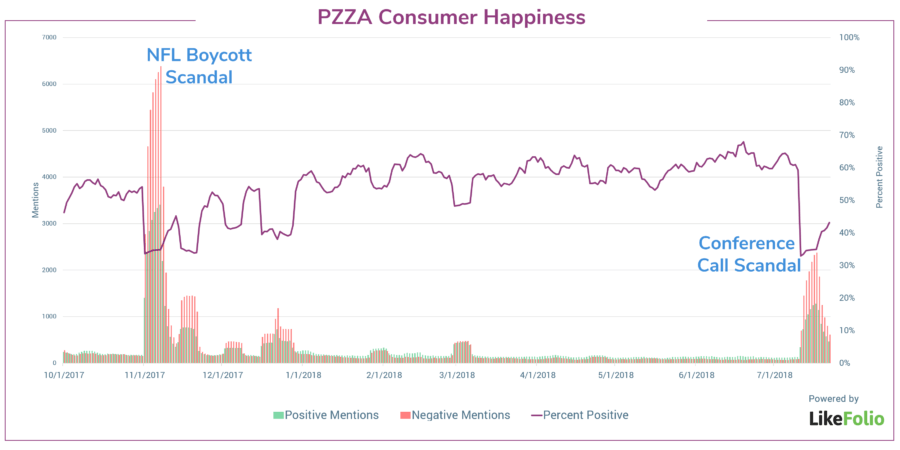
A survey done by Weber Shandwick estimated that 44% of a company’s market value is attributable to CEO reputation. Furthermore, another survey found that 95% of financial and industry analysts said they would purchase stock based upon a CEO’s reputation. And 94% said they would recommend the stock to others based on the CEO’s reputation. As you can see, CEO reputation is responsible for a massive amount of shareholder value.
CEO reputation affects employees
We live in a world where everything is just one Google search away. As a result prospective employees are heavily influenced by what they discover online. That’s especially true of negative Glassdoor reviews or unfavorable posts on social media platforms like LinkedIn.
Furthermore, a positive CEO reputation fosters brand trust, which helps retain loyal employees. That, in turn, drives down the cost of constantly training new hires.
Glassdoor recently compiled a list of the Top 10 CEOs. What’s interesting is that they share many common traits. For instance, they…
- Foster a culture of transparency and accountability among themselves and employees at every level.
- Are dedicated to solving the day-to-day issues facing leadership .
- Present a strong, real-world and online presence for their business.
A CEO’s online reputation is crucial in forming the workforce that drives successful Fortune 500 companies.
CEOs influence corporate reputation and media coverage
According to a 2020 commissioned study by Forrester Consulting, nearly three-quarters (74%) of respondents believe their customers moderately to considerably tie their perception of a brand to their perception of its executives.
So, company reputation and CEO reputation are intimately connected in the eyes of customers. Which means, when business leaders get negative media exposure, the press ties this story to the company’s reputation, fueling the need for additional corporate reputation management.
Ultimately, it’s much more difficult to sell products and services when the CEO fails to foster public trust.
Your career and legacy
2019 saw the most CEO departures on record. And some notable figures were let go for a single reputation-damaging event. In December of that year alone, a shocking 160 CEOs left their posts. As one example, the founder of the luggage company Away left after reports that she fostered a toxic work environment.
These departures cost corporations hundreds of millions of dollars in compensation packages. Moreover, a negative reputation hurts your marketability as a top performing business leader.
CEOs as brand ambassadors
In the past, it was much simpler to be the CEO of a large company. Long before the days of Yelp, Facebook, Twitter, LinkedIn, and the 24-hour news cycle, CEOs were mostly concerned with quietly running the business and keeping investors informed and satisfied.
Today’s CEOs are jacks and jills of all trades. Not only are they running the company from the top, but are also expected to be more public-facing and available (and accountable) to staff, stakeholders, and customers alike. CEOs are also expected to perform crisis management with tact and extreme sensitivity. And they must possess ever-evolving thought leadership skills and ingenuity. Today, a CEO’s toolbox has to be bigger than ever before.
Proven CEO reputation management tactics
CEO reputation management protects your business, your legacy and your personal brand. A comprehensive ORM strategy can mitigate negative search results from Google while establishing a more well-rounded and accurate online presence.
The following tactics provide a general overview of how ORM works.
1. Map your online narrative
The first step of executive reputation management is to Google your name and map out your complete search landscape. Taking the pulse of your online presence means looking far beyond the first page of Google. In fact, we perform sentiment analysis against the first 500 search results for our customers. Although it’s an arduous process, it’s necessary to understand how Google perceives you.
2. Identify risks and opportunities
Once you have a better sense of what your Google search results look like, you’ll want to assess your reputation risk. Many CEOs are familiar with enterprise risk management which aims to minimize the cost of strategic risk. However, reputational risk management is far more nebulous. It attempts to measure the fiscal impact of viral news cycles and negative news articles on a brand.
You’ll need to do more than identify potential risks. You’ll also need a keen eye for opportunity. It’s not enough to own just one static web property. You need to control as many domains as possible to manage your online reputation. So, bulk out your social media profiles, online platforms, and other public-facing digital assets. You should also take inventory of your allies and build your network.
3. Optimize existing preferred content
In order to really own your search landscape, you’ll need to optimize your existing content to target the correct keyword groups. Then, you’ll need to earn plenty of backlinks to make sure your customers and shareholders discover the positive content that tells your story.
This is perhaps the most time-consuming part of CEO reputation management.
4. Strategically create new content
Once you’ve optimized your existing content, you’ll need to build up your web assets through content like keyword-focused blogs, frequent and engaging posts on social media accounts, and captivating press releases. Since relevant, timely, high-quality content about executives has the best chance of ranking well in the SERPs, many of our customers extend their contracts with us for years after we resolve their initial issue to future-proof their reputation.
5. Coordinate PR and CEO reputation management
An important part of a CEO reputation management plan includes coordinating messaging with your company’s public relation (PR) firm. This allows you to promote the good things that you and your company are doing to improve the world through timely press releases. As a result, you’ll boost your personal image as well as your brand’s reputation.
6. Bury unfavorable search results and articles
It’s highly unlikely that Google will remove news articles about a CEO, especially if that content is featured by a major publisher or syndicate.
A study conducted by Moz found that merely 7 percent of those surveyed said they browse past the first page of search results. That means the vast majority of searchers wouldn’t even see your content if it was pushed off the front page. Burying unfavorable content in the SERPs allows you to craft the narrative you want others to see. And executives agree this strategy is important to business success.
Consider these reputation management statistics from a new commissioned study by Forrester Consulting. Nearly 70% of executives associate SEO strategy with improved brand perception. Additionally, 54% of executives believe reducing unfavorable search results would drive revenue growth.
CEO reputation management takes time – start now
Online reputation repair isn’t something to take lightly if you’re a fortune 500 executive. Don’t expect firms that work with small businesses and local companies to be able to fix search results that contain articles from top-tier news organizations.
We have a proven track record and case studies to back up our results.
What is reputational risk?
By definition, reputational risk refers to the potential for negative publicity, public perception or uncontrollable events to have an adverse impact on a company’s reputation, thereby affecting its revenue.
Reputational risk strikes without warning and shifts your corporate landscape. Even worse, it injects an unfavorable narrative into your search results which affects customer opinions and impacts revenue. There are countless statistics about online reputation that support this conclusion. We commissioned a study by Forrester Consulting to find out what executives at large brands think about SEO strategy and reputation.
- 43% of executives think removing unwanted search results would increase sales
- 43% of brands believe improving search results would increase conversion rates
- 42% of brands say search results are tied to lead generation
- 38% of brands believe minimizing unfavorable search results would improve close rates
54% of executives believe reducing unfavorable search results would drive revenue growth
Reputation risk vs strategic risk
Unfortunately, reputational risk is often neglected or confused with other types of corporate risk. Let’s look at how they all relate to one another.
Strategic risk is specific, measurable and predictable. Therefore it is controllable.
Reputation risk, on the other hand, is largely unpredictable. In fact, it can even be tied to events that aren’t your company’s fault. Still, opinions of clients, investors, business partners and the general public can have a profound impact on your firm’s revenue. Therefore, it’s critical to be aware of hazards that result in reputational damage to a business.
Types and causes of reputational risk
There are numerous types of risk to guard against, including outside adverse events, workplace practices, data retention failures, product recalls, bad financial statements, and CEO reputation issues. Let’s dive into the scenarios that pose the greatest threat.
CEOs, company leadership and employees
If your CEO has a negative reputation, then so does your company. And that, ultimately, affects revenue, investments and shareholder value. That’s because a CEO’s reputation cannot be separated from that of the company, and vice versa.
Executives attribute 45% of their company’s reputation to the CEO’s reputation
25% of a company’s market value is directly attributable to its reputation
Even if a beleaguered CEO leaves the company, his or her reputation may continue to damage the brand. That can make it difficult and expensive to find a replacement, and could further feed the negative news cycle.
Company leaders aren’t the sole source of reputational risk; any of your employees could spark public outrage. Imagine the consequences in each of the following scenarios:
- A bank teller or branch manager calls the police for racially motivated reasons
- One of your wealth managers refuses to serve a gay couple
- A director at your VC firm is accused of sexual misconduct
Any of those situations could cause a viral news cycle that results in boycotts, customer defection, and significant revenue loss for years.
Negative articles
Company layoffs, lawsuits, scandals and regulatory penalties can impact revenue for years. Whether brought on by unsettled employee disputes, customer complaints or regulation violations, negative media attention can shackle profits for global banks, financial services companies and other businesses.
According to a commissioned study by Forrester Consulting, 42% of brands believe reducing unfavorable search results would improve lead generation. Moreover, 54% of executives believe improving search results would drive revenue growth.
Furthermore, sometimes good business decisions don’t sit well with employees or the press. Events like mergers and acquisitions or closing down an underperforming factory could trigger negative articles that damage your reputation.
Maybe an old article won’t go away. Or perhaps something from the past resurfaced. Whatever it is, we can help mitigate your brand’s reputational risk.
Let’s discuss how much a negative reputation is costing your brand.
Social media
Social media can be both a cause and a catalyst for a negative reputation. When company leaders post controversial comments online, their statements affect the entire business, not just the executive’s reputation.
Additionally, unsolicited brand mentions by influential political figures or celebrities can also lead to social media backlash. Although your company may have been casually mentioned, the public will likely infer a reciprocal endorsement.
Furthermore, social networks can amplify negative press that may otherwise have gone unnoticed.
Services and pricing
Whatever your business model, if your company underperforms or overcharges, it will eventually develop a bad reputation. For example, a journalist may publish an expose about shady sales techniques or reveal hidden fees. Or a financial analyst could write a damaging article about the quality of your investment funds.
Data loss
Your customers trust you with their data. In fact, finance companies handle some of the most sensitive personal information, including: names, social security numbers, passwords, logins, pin numbers and bank account numbers. A data breach will corrode your institution’s reputation and could cost you hundreds of millions of dollars.
Regulation changes
Government regulations can change with each election cycle. Under one administration your bank may meet stress test requirements, and under another you could face liquidity risk. When the public thinks your financial institution is unstable, they’ll take their money to your competitors.
Reputational damage
Your business’s reputation is your most valuable asset, especially if you’re a bank or financial institution.
A negative corporate reputation harms client and investor trust, erodes your customer base and hinders sales. A poor reputation also correlates with increased costs for hiring and retention which degrades operating margins and prevents higher returns.
Furthermore, reputational damage increases liquidity risk which impacts stock price and ultimately slashes market capitalization.
Reputational risk examples for banks
Wells Fargo is probably the best example of the impact of reputational risk. The bank’s employees opened millions of fake accounts, overcharged for mortgage insurance, signed up customers for unnecessary car and pet insurance and accidentally foreclosed on hundreds of homes.
Those actions prompted the bank to take the following actions to mitigate reputational risk:
- Fired 5,300 workers
- Replaced longtime CEO
- Replaced board chairman and directors
- Paid $185 million to atone for shady sales practices
- Reserved $285 million to refund wealth-management clients for pricing and fees
“There’s no question that Wells Fargo’s scandals are responsible for seriously eroding shareholder value.”
William Klepper, management professor at Columbia Business School
As a result, the wealth and investment management unit has struggled to generate new business. The Federal Reserve also limited Wells Fargo’s growth until the bank changes its management and risk control procedures.
These incidents, coupled with the soured reputation of the former CEO, have created a substantially negative online presence that’s hyper-saturated with bad press. If Wells Fargo wants to recover their damaged reputation, they’ll need to make a significant investment in enterprise-level reputation management
Next, let’s look at some reputation risk management best practices.
Four steps of reputation risk management
It’s important to develop a framework for managing reputational risk prior to an issue. The following steps will help you measure, monitor, manage and mitigate damage to your reputation.
1. Measuring reputational risk
Step one is to execute a reputational risk assessment to establish the baseline for your company’s image. That will help you determine public perception of your company and competitors as well as the industry in which you operate.
Reputational risk is highly subjective. So, segment your stakeholders into separate groups to determine areas of exposure. You may want to include regulators, analysts, investors, clients or employees.
Next, indicate the level of danger for each segment. For example, you may use a numeric scale or colors. See the reputational risk assessment template below:
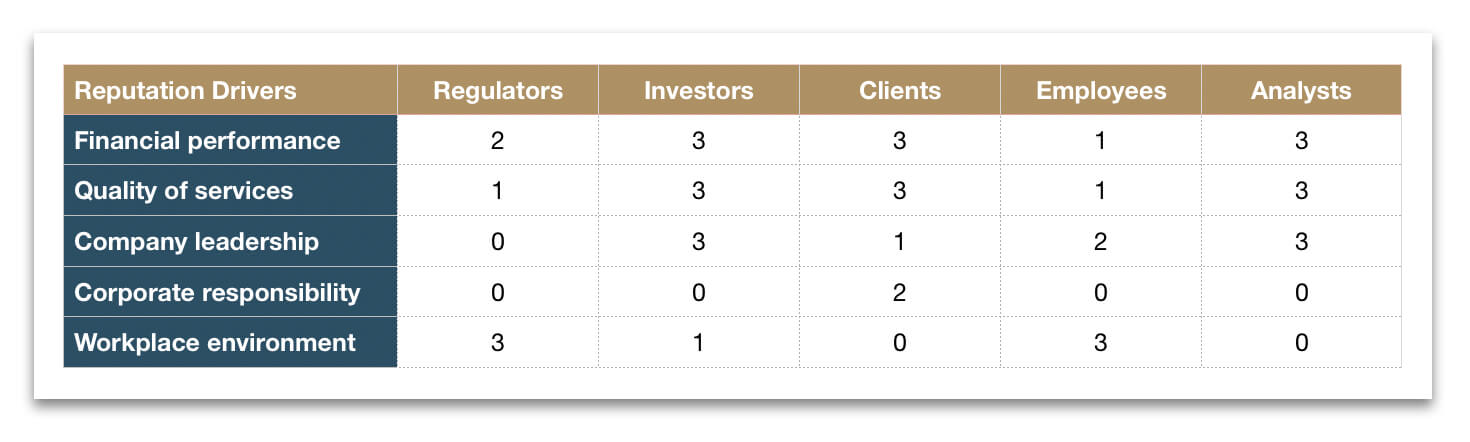
Finally, take inventory of each groups’ perception of your company. This can be accomplished through internal and external surveys or search engines. All media outlets worth their salt have an online presence. So, search engines are incredibly useful reputational risk assessment tools.
However, brand sentiment analysis isn’t as easy as popping your organization’s name into Google. You’ll need to analyze discussion topic density within Google’s index to determine the underlying drivers of unfavorable content. Then, you can set goals around diluting those narratives.
It’s best to enlist the help of online reputation management services like our company to help you quantify and mitigate reputational risk. We mine insights from hundreds of listings in your search results to inform our strategy. Then, we develop a roadmap to naturally inject favorable, forward thinking discussion topics about your brand into Google’s index. This desaturates unfavorable narratives and allows more evergreen assets to anchor your search landscape.
If you want to attempt things yourself, use a reputational risk assessment matrix like the one below to designate the severity of all neutral and negative content.
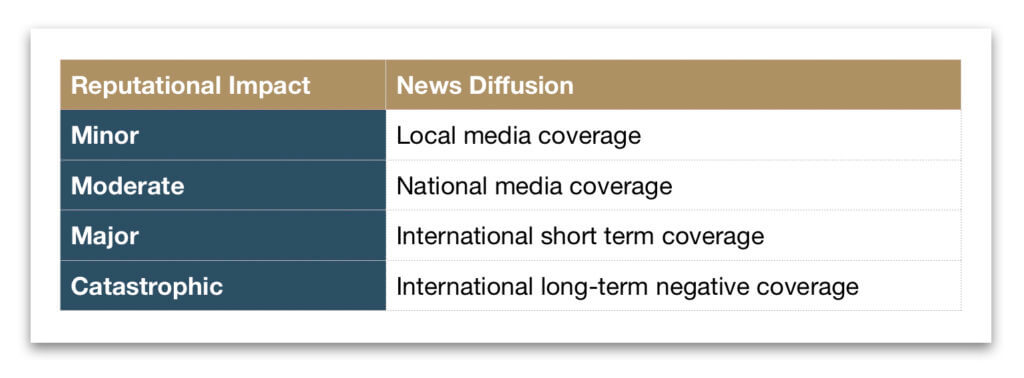
2. Managing reputational risk
Use your assessment as a framework to develop a reputational risk management plan. You may need to create more than one process or strategy depending upon the type of risk your firm is exposed to.
For example, racial discrimination accusations will require a different approach than customer complaints or inappropriate CEO comments on social media.
It’s impossible to offer specific recommendations for this step because there are an infinite number of possibilities. Ultimately, it’s best to work with a crisis management firm or public relations agency to resolve an active crisis as quickly as possible.
Then, invest in a corporate reputation management strategy to restore your search results.
3. Mitigate reputational risk with ORM
Once your situation is under control, you’ll need to mitigate the damage to your brand’s image through online reputation management (ORM). That process involves syncing your company’s online presence with its real-world accomplishments.
However, it’s no small feat to influence a large organization’s Google results. This requires social media management, brand management, content creation, strategic outreach, digital asset creation, and most importantly search engine optimization. I can’t overstate the importance of working with the right reputation management company.
In addition, firms should run marketing campaigns to shift the negative narrative and repair a damaged reputation. Use those campaigns to promote your company’s corporate social responsibility programs (CSR).
4. Monitor your reputation
The final step in a reputational risk management program is to diligently track brand perception against your baseline. Monitor opinions of employees, customers, vendors, shareholders, analysts and activists. Here are just a few ways you can continuously monitor brand reputation:
- Run surveys
- Hire a brand sentiment tracking agency
- Set up Google alerts
- Manually search your brand and your executives Google
- Work with a reputation management company like us
Reputational risk insurance policies
Reputational risk is a massive expense that squeezes your bottom line. What’s worse, it may even go undetected for years. Because it poses such a substantial threat, company’s might consider taking out a reputational risk insurance policy.
While insurance can help pay for the cost of a damaged brand image, it won’t fix the underlying issue. Therefore, is the cost really worth it? Rather than wasting capital on reputation risk insurance, consider strengthening your online presence instead.
Most senior executives and business owners admit that corporate reputation management is much more important than it used to be. But many large organizations don’t have a strategy to manage online brand perception.
What is corporate reputation management?
Corporate reputation management is much more than media relations and press release distribution. It fuses search engine optimization, social media management, brand management, reputation marketing, contents creation and public relations into a single service.
Our corporate online reputation management solution repairs your company’s branded search results which directly impact revenue and growth.
Importance of corporate reputation
Consumers don’t interact with brands in the same way they used to. Before social media sites and search engines, people heavily relied on word of mouth to determine which businesses to trust. But now they rely on Google searches and review platforms like Yelp and Ripoff Report to learn about an organization’s reputation.
Every day, billions of potential customers turn to search engine results to research brands before they make a purchase. Bad reviews and negative feedback on social networks even affect corporate reputation in many ways.
When negative content creeps into a corporation’s search results it impacts the entire business. Chief executives and key stakeholders get distracted from important initiatives, or worse, they may even exit the company. Shareholder and investor relations become strained. Marketing grinds to a halt, and loyal customers may switch to competitors.
Consider these concerning reputation management statistics:
- 92% of consumers are less likely to use a business with bad reviews. — BrightLocal
- 69% of job-seekers won’t apply to companies with online reputation issues.
- 41% of companies have reported loss of revenue from a reputation-related event.
- Businesses with a negative reputation spend 10% more per hire — HBR
25% of a company’s market value is derived from its reputation.
A commissioned study by Forrester Consulting found that unfavorable search results impact consumer trust, shareholder trust and brand perception. The same study revealed that 54% of executives believe reducing unfavorable search results would drive revenue growth.
As a company leader, it’s your duty to help build a defensible, positive online reputation that protects your organization from reputational risk. Our world-class corporate reputation management strategies are the answer.
Why you need corporate reputation management
A damaged corporate reputation won’t self-correct. In fact, it will often spread like a virus because people tend to gravitate towards negative stories.
For example, if your search results contain a negative review, consumers will be more likely to leave one themselves. Similarly, if journalists find an unfavorable news story about your brand, they might write another one and link to the first. As a result of users clicking on and linking to your negative content, Google will rank it higher in the SERPs.
Let’s take a look at the most common problems that our corporate ORM services solve.
Lack of a strong online presence
Most businesses don’t grow into successful corporations unless they take care of their customers and employees along the way. However, there’s a big difference between a great company and a great online reputation. Let me explain:
Perhaps you offer competitive salaries, desirable benefits and interesting perks. Your employees love their jobs, but they don’t write employer reviews so nobody knows how great your company is. Further, if one rogue individual writes a negative review, people may assume that it represents your entire employee base.
Here’s another example: You provide B2B services for global companies, and customers recognize you as the industry leader. Unfortunately, your industry rarely receives media coverage apart from a few unread press releases. As a result, one negative news article could infiltrate your search landscape.
When your company is underrepresented online, it’s vulnerable to reputational damage from unfavorable search results. Our corporate reputation management services will strengthen your brand’s online presence while protecting it from future incidents.
Negative online reviews
Review sites often rank near the top of Google for branded search queries. That’s bad news if you haven’t actively solicited positive reviews from happy customers and employees. In fact, you may need to earn as many as twelve positive customer reviews to offset a single negative review.
One-star reviews from employees on sites like Glassdoor and Indeed are even more problematic. Not only could those complaints influence customer decision making, but they may also scare away top talent.
Negative articles about companies or executives
Fortune 500 corporations and CEOs are no strangers to bad press. Missed revenue goals, product recalls and scandals involving business leaders can all spark negative news articles. Even worse, if your company is well-known to the general public, bad news could go viral.
Social media backlash
Highly-engaged social media followers are an incredible brand asset. But be warned; they can quickly turn on you if you post something at odds with their beliefs.
Angry followers aren’t the only pitfall you need to avoid. Trolls are constantly on the lookout for any type of social media blunder to exploit. Don’t assume you can solve the problem by simply deleting negative comments and blocking followers, because doing so will only make things worse. You’ll need to handle those situations very delicately.
Corporate crisis & issues management
Corporate reputation consulting services also help to mitigate reputational damage in the event of a crisis. A robust online presence can hold back bad press, but that’s not all. When you control more digital assets you can deliver key messaging more accurately.
Corporate reputation management strategy
A good reputation doesn’t exist in a bubble. It takes a carefully-mapped process and continuous action to protect your reputation from danger. Our strategies are custom-built for each client, but we often draw from the following tactics to address search issues:
Our corporate reputation management process
- Expand your social media presence – We’ll claim untapped networks and social media accounts and optimize your profiles to rank for branded search queries.
- Publish positive content – We’ll amplify your corporate social responsibility initiatives and ensure online publishers are talking about your good corporate citizenship. We’ll also publish and promote positive news about company culture, growth and hiring.
- Build brand expertise, authority and trust – We can leverage company leaders and senior executives to bolster your online presence through earned media mentions and thought leadership articles.
- Continuously monitor online mentions – We’ll discover and address negative content immediately. Finding harmful search results quickly will keep them from securing a foothold on page one of Google as well as other search engines.
- Leverage search engine optimization to boost positive content – corporate brand management won’t be successful unless it’s underpinned by search engine optimization. The bigger your brand’s reputation issue is, the more critical SEO becomes.
Don’t wait until it’s too late
Your company’s reputation is much too valuable to leave unattended. Our world-class corporate reputation management team has helped companies and executives who control hundreds of billions of dollars in market capitalization with ORM issues. Managing corporate reputation and risk takes expertise, commitment, and experience.